from an article at: Green Energy News
Nowadays, most people probably agree that we need to drink plenty of water in order to stay healthy, avoid dehydration and to function efficiently. The exact quantity of water that you need will vary according to your body mass and size, climatic conditions you find yourself in and the level of physical activity in which you are engaged. However, most medical authorities currently suggest that your daily water intake should be between six and eight large glasses of water.
This perfectly sound medical advice has been one factor used in the advertising campaigns of bottled water suppliers to very effectively market their product. The bottled water market is relatively new – but it is very large. Consumer demand for bottled water more than doubled between 1997 and 2005, and over 200 billion bottles of water are sold worldwide per annum.
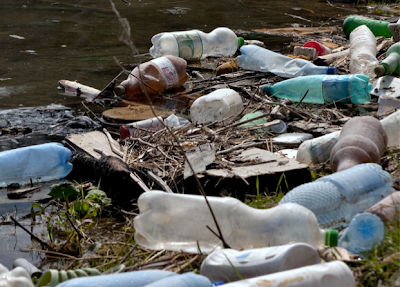
That’s a massive amount of empty bottles being thrown away. Some – a little less than a quarter of the total according to current statistics – are recycled. The rest end up as landfill. The environmental consequences are significant. If all of those empty bottles were aligned end to end, they would span a distance covered long enough to get to the moon and back – 56 times!
The amount of carbon emissions involved, both in the production of the bottles and the transportation of the finished product, is also worthy of consideration. It’s an amazing fact that the production of the bottles uses three times as much water as the bottles contain when they are shipped.
Bottled water is, simply put, an environmental disaster. Of course, it’s not out of the question that you may be more worried about your own health than that of the planet – which may well be understandable in many cases. The problem with this logic is that there is absolutely no evidence that bottled water is better for your health than common or garden tap water.
Tap water in North America and Europe is perfectly safe to drink and is subject to stringent checks. Some bottled water has been found to contain traces of uranium and estrogen chemicals. Some of the chemicals found in bottled water are as a result of “leeching” from the plastic (PET) bottles. It’s also established that many bottled waters contain, along with other minerals, salt – which is not very good for your blood pressure.
The only reason you might conceivably be tempted to use bottled water would be the taste. However, in blind taste tests most consumers are unable to tell the difference between bottled water and tap water. Of course, if your house is in a hard water area, or if you just don’t like the taste of your tap water (perhaps due to chlorine which is often used by the water supplier to kill bacteria) you may wish to evluate other alternatives.
You could consider using a home filtration system – which will be better for the environment, better for your health and very much cheaper than bottled water. You can install whole house filtration systems, under sink filters. All of these solutions will remove contaminants, enhance taste and reduce water hardness in a manner which is environmentally friendly.
Showing posts with label reusable bottles. Show all posts
Showing posts with label reusable bottles. Show all posts
Sunday, August 15, 2010


Wednesday, August 11, 2010
Top of the Queue: ‘Tapped’ an anything but dry look at bottled water
From an article in 77Square:
By ROB THOMAS | The Capital Times | rthomas@madison.com | Posted: Tuesday, August 10, 2010 4:45 am

By ROB THOMAS | The Capital Times | rthomas@madison.com | Posted: Tuesday, August 10, 2010 4:45 am
Top of the Queue: ‘Tapped’ an anything but dry look at bottled water

Customers buy bottled water from Costco in this 2007 photo. The new documentary “Tapped” looks at the environmental impact of the bottled-water industry.
If you watch enough documentaries about the imminent catastrophes facing humanity, the upside is that one calamity ends up solving another. I watched “Countdown to Zero,” about the world’s nuclear threat, (see review on page 13) right before watching “Tapped,” about the world’s precarious clean water supply.
And, on the bright side, if nuclear annihilation does come, we won’t have to fret too much about two-thirds of the planet not having access to clean drinking water by 2030, right?
All kidding aside (and, really, you have to have some sense of humor after wading through these, “An Inconvenient Truth,” “Food Inc.” and others), “Tapped” caught me a little off guard. You might think that a documentary on the water supply might be a little (ahem) dry, but it’s an engaging and enraging look at the environmental impact of the bottled water industry. “Tapped” comes out on DVD this week.
Although I suppose I shouldn’t be so surprised, as “Tapped” was made by the producers of the excellent documentary “Who Killed the Electric Car?” In that film, like many of the new wave of environmental documentaries, filmmakers are looking for emotional narratives through which they can tell their stories and present their cases.
In “Tapped,” it’s often the classic David vs. Goliath struggle of ordinary folk against the big bottling companies. While most water bottles feature mountain springs and peaks on their labels, two out of every five bottles come from a municipal tap. The movie estimates bottling companies like Pepsico pay between six and 11 cents per gallon for water, yet a gallon of that water costs more to a consumer than a gallon of gasoline.
While the health and environmental risks of bottled water are well covered in the film (only one in five of the bottles, which are often carried by folks on the go, end up recycled) I was especially interested to see the marketing triumph of bottled water; how we were convinced to buy something that we get for free from the bathroom faucet.
Director Stephanie Soechtig does give representatives for the bottled-water industry time to air their dissenting views on her film’s thesis, and I have to admit, I do love when she puts them on the spot, turning their own talking points against them. When one claims they don’t really consider tap water the enemy, she leaves him almost dumbstruck when she pulls out a quote from a Pepsico executive who said, in 2000, “The biggest enemy is tap water.” Whoops.
“Tapped” clocks in at a breezy 78 minutes and has a lively tone that includes MGMT and Radiohead (“Fake Plastic Trees,” of course) on the soundtrack. The message about bottled water seems to be getting through; at Lollapalooza last weekend, water was only sold in recyclable cardboard containers. They were easily broken down and tossed in a recycling bin — right next to the piles of soft drink bottles sold at the festival.
For a slightly different take on water rights issues, check out the documentary “Flow” (which played at Sundance Cinemas). “Flow” looks at the growing movement to privatize the world’s water supply. An absolute must-see documentary about the creatures who live in water is the Oscar-winning “The Cove,” a suspenseful and sobering film about a group of activists who try to expose a dolphin-slaughtering operation in Japan.
And, on the bright side, if nuclear annihilation does come, we won’t have to fret too much about two-thirds of the planet not having access to clean drinking water by 2030, right?
All kidding aside (and, really, you have to have some sense of humor after wading through these, “An Inconvenient Truth,” “Food Inc.” and others), “Tapped” caught me a little off guard. You might think that a documentary on the water supply might be a little (ahem) dry, but it’s an engaging and enraging look at the environmental impact of the bottled water industry. “Tapped” comes out on DVD this week.
Although I suppose I shouldn’t be so surprised, as “Tapped” was made by the producers of the excellent documentary “Who Killed the Electric Car?” In that film, like many of the new wave of environmental documentaries, filmmakers are looking for emotional narratives through which they can tell their stories and present their cases.
In “Tapped,” it’s often the classic David vs. Goliath struggle of ordinary folk against the big bottling companies. While most water bottles feature mountain springs and peaks on their labels, two out of every five bottles come from a municipal tap. The movie estimates bottling companies like Pepsico pay between six and 11 cents per gallon for water, yet a gallon of that water costs more to a consumer than a gallon of gasoline.
While the health and environmental risks of bottled water are well covered in the film (only one in five of the bottles, which are often carried by folks on the go, end up recycled) I was especially interested to see the marketing triumph of bottled water; how we were convinced to buy something that we get for free from the bathroom faucet.
Director Stephanie Soechtig does give representatives for the bottled-water industry time to air their dissenting views on her film’s thesis, and I have to admit, I do love when she puts them on the spot, turning their own talking points against them. When one claims they don’t really consider tap water the enemy, she leaves him almost dumbstruck when she pulls out a quote from a Pepsico executive who said, in 2000, “The biggest enemy is tap water.” Whoops.
“Tapped” clocks in at a breezy 78 minutes and has a lively tone that includes MGMT and Radiohead (“Fake Plastic Trees,” of course) on the soundtrack. The message about bottled water seems to be getting through; at Lollapalooza last weekend, water was only sold in recyclable cardboard containers. They were easily broken down and tossed in a recycling bin — right next to the piles of soft drink bottles sold at the festival.
For a slightly different take on water rights issues, check out the documentary “Flow” (which played at Sundance Cinemas). “Flow” looks at the growing movement to privatize the world’s water supply. An absolute must-see documentary about the creatures who live in water is the Oscar-winning “The Cove,” a suspenseful and sobering film about a group of activists who try to expose a dolphin-slaughtering operation in Japan.
Monday, August 9, 2010
How can we keep doing it?
The evidence against the use of plastics for ANYTHING disposable is now overwhelming. Plastics are made from oil. Oil is a resource millions of years in the making and that has been largely used up in just 100 years. Once oil is out of the ground, no matter what you do with it, it is a problem. This can manifest as an oil spill – and the Gulf of Mexico is just the “Ben Hur” of something that goes on every day. It can be when we burn the oil and create air pollutants and greenhouse gas. It can be when we make petrochemical fertilizers and basically “mine” our farmland, leaving it dead and depleted after a few years. It can be in polymers and plastics, which are used for a very short time and then break into tiny particles that, asbestos like, dissipate throughout the environment causing damage in ways we will never know – that prize understanding will be for some distant future generations, who will also have the task of cleaning up or trying to live with our mess.
So how, knowing this, can we keep doing it? How come we are so perverse, so “easy going” in our treatment of the only place in the universe where we can have a life? What stops us using just a little bit of our personal energy and doing whatever it takes to NEVER buy throw away plastics? Because that is what it takes. That is what we need to do, much more than just “get through the day.” More than pay the mortgage, more than cope with another emergency. We need to understand very clearly the difference between what is urgent and what is important. It is important to stop using plastic throw away bottles. Really simple. It is important to take that understanding and slowly expand it to apply to other forms of plastic, and then other unnecessary but “easy” uses of oil. It is important to see, we are just the dust of this earth, made into humans for a little while, and then all our molecules will rejoin the dust again.
This is our earth. We are it, and we are killing it. It is important to stop this self abuse.
Tap Water – get something real into you.


Tuesday, August 3, 2010
Bottled Water is a Symbol of Modern Day Consumerism. A Symbol we Don’t Need.
from an article in uncluttered white spaces


Bottled water is simply an indulgence for western culture, and despite the stories we tell ourselves, it is not a benign indulgence. The USA alone are moving 1 billion bottles of water around a week in ships, trains, and trucks. Picture this, that is the same as 37,800 full size trucks delivering water a week. Water is heavy, so heavy in fact that you can’t fill an 18-wheeler with bottled water–you have to leave quite a lot of empty space. Yep, ouch!
Fair to say, that one out of six people in the world has no dependable, safe drinking water. So our global economy has contrived to deny the most fundamental element of life to 1 billion people, while delivering to us an array of water “varieties” from around the globe, not one of which we actually need. Lets repeat that… “NOT ONE OF WHICH WE NEED!
A chilled plastic bottle of water in a shop fridge is the perfect symbol of modern day consumerism and the laziness for western culture. It acknowledges our demand for instant gratification, our vanity, ignorance for health related issues and environmental problems.
OK, it’s just a bottle of water, I can hear you saying so what, this has no impact compared with the indulgence of driving a bullet proof Hummer. A whole industry has been created to supply us, Australians, Americans, Canadians, Brazilians, Kiwi’s… any nation for that matter with safe drinking water something that we dont actually need. And we keep on buying it.
We buy bottled water because we think it’s healthy. Which it is, of course: Every kid who buys a bottle of water from a vending machine instead of a bottled of Coke is in-arguably making a healthier choice. But bottled water isn’t healthier, or safer, than tap water. Its the same thing. Its just water. Consider this… If the water we use at home cost what the cheapest bottled water costs us, then our monthly water bills would run around $9,000.
Considering half the price of a typical $2.00 bottle goes to the retailer. Around one third goes to the distributor and transport. Another 15 to 20 cents is the cost of the water itself, the bottle and the cap.We are just lining pockets. Chris Guillebeau wrote an article that saving $2 a day will take you anywhere you want to go in the world within 2 years. Most people I know spend a lot more than that on bottled water and complain they cant afford to go anywhere for their holidays. Maybe they should subscribe to Chris’s insanely good blog.
The label on a bottle of Fiji Water says “from the islands of Fiji.” Take a trip to the source of that water, and you realize just how amazing that promise is. From New York it is an 18-hour plane ride west (via Los Angeles) almost to Australia, and then a four-hour drive along Fiji’s two-lane King’s Highway. Every bottle of Fiji Water goes on its own version of this trip, in reverse, although by truck and ship. In fact, since the plastic for the bottles is shipped to Fiji first, the bottles’ journey is even longer. Half the wholesale cost of Fiji Water is transportation–which is to say, it costs as much to ship Fiji Water across the oceans and truck it to warehouses in the United States than it does to extract the water and bottle it. What a joke.
We pitch into landfills 38 billion water bottles a year–in excess of $1 billion worth of plastic.
Bottled water is not a sin. But it is a choice. Once you understand the process and resource used to create and deliver the bottle of water, ask yourself this question “Does the $2 I am about to spend equal the impact I’m about to leave behind?” Especially when your kitchen sink is available every morning ready to refresh.
Simply asking the question takes the carelessness out of the transaction. And once you understand where the water comes from, and how it got here, it’s hard to look at that bottle in the same way again.
Saturday, July 17, 2010
9 reasons to ditch the plastic water bottles
From an article at ecosalon

Bottled water is everywhere. Supermarkets, gas stations, even vending machines offer it, but there are compelling reasons to kick the bottle habit for good.
9. Cost: A single bottle of water generally runs about one to two dollars. In some cases, such as at concerts or amusement parks, one bottle can cost up to nearly three dollars! Even if bottled water is bought in bulk, the price still averages around .50 to .89 cents per bottle. Filtered tap water is essentially the same product and costs a fraction of the price.




1. Redundancy: It takes a ridiculous amount of water to make one bottle of water! Some studies suggest that it takes nearly seven times as much water to make just one consumable bottle!


Bottled water is everywhere. Supermarkets, gas stations, even vending machines offer it, but there are compelling reasons to kick the bottle habit for good.
9. Cost: A single bottle of water generally runs about one to two dollars. In some cases, such as at concerts or amusement parks, one bottle can cost up to nearly three dollars! Even if bottled water is bought in bulk, the price still averages around .50 to .89 cents per bottle. Filtered tap water is essentially the same product and costs a fraction of the price.

. Space: Many people live in environments where space is at a premium. One reusable bottle takes up much less space than 12 bottles of the same product.

7. Waste: In a perfect world, everyone would recycle their used bottles. All it takes is a quick drive down the highway to realize that we live in a far from perfect world. Old plastic bottles littering the curb are a common sight, unfortunately. Even in a garbage dump, one bottle can take thousands of years to decompose.

6. Environmental impact: Litter aside, bottled water takes a greater toll on our environment. Oil goes into making the plastic. Large trucks need to be fueled up to transport them, emitting extra fumes into the air. The bottles are usually kept cool in the store, using up even more unnecessary energy.

5. Quality: Bottled water has a reputation for being “safe”, but this isn’t necessarily true. Under extreme heat, like that found in a vehicle in summer, chemicals can be leached from the plastic and contaminate the water within.

4. Regulations: Consider this; the EPA holds tap water to much higher standards than the FDA holds bottled water, meaning there is a chance that bottled water is not as safe as filtered tap water.

3. Not So Pure: Bottled water companies claim their water is “purer,” often toted as spring water or more organic. Take a closer look at the label though. If the words “from a municipal/community source” are present, that water is likely to be no more than glorified tap water. Consumers can have the same taste and effect by attaching a filter to their faucets.

2. Community effect: Bottled water is pulled from local sources near the bottling plant, leading to water shortages in the immediate area. Farmers and local residents take the brunt of the impact at first, but everyone feels the crunch in higher food costs and shortages.


Doesn’t it make more sense to ditch to bottle?
Subscribe to:
Posts (Atom)