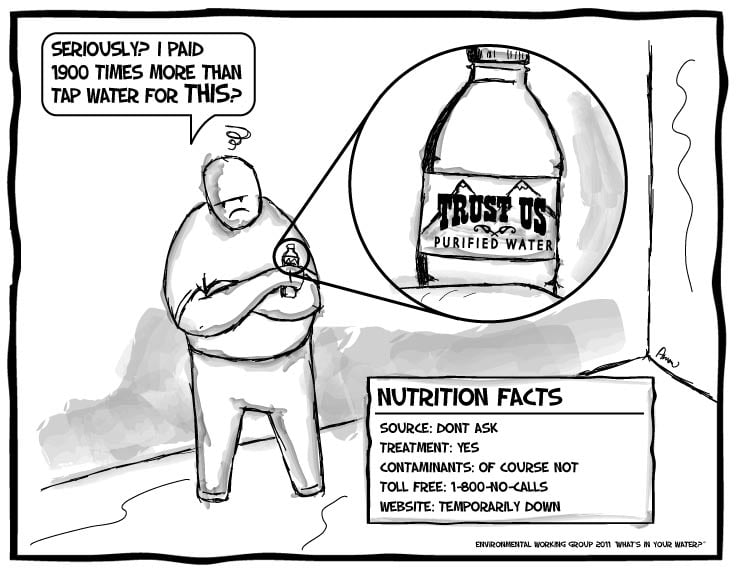
from an article at philSTAR.com |
|

Computer graphics by REY RIVERA
| Zoom
| Zoom
The long hot summer is here! And suddenly, all I can think of is a most refreshing drink of water to quench my thirst, wash away the day’s blahs, and soothe my weary spirit.
So, I grab a bottle of water (never cold, just room temperature water and not because of the mistaken notion that drinking cold water makes you fat, but that’s another story), open my e-mail and read this riveting item from Yahoo Green: “The Environmental Working Group (EWG is an American environmental organization) analyzed the company websites and product labels of over 170 varieties of bottled water in the US to see if the companies disclosed information on where their water came from, how the water was treated, and whether the results of tests to ensure purity were revealed.”
Thirsty for more information, the researchers also called the bottled water companies to ask if they would be willing to share information with consumers.
And the findings are: “More than half of the bottled water products failed the transparency test. Almost 20 percent didn’t say where their water comes from, and an additional 32 percent did not disclose any information on treatment or purity of water.”
Yahoo Green pours out more absorbing facts: Only three brands earned the highest possible marks Gerber Pure Purified Water, Nestle Pure Life Purified Water, and Penta Ultra-Purified Water.
A great majority of the bottled water companies refuse to divulge what’s really in their bottles. There are just a lot of bottled-up truths that consumers ought to know.
Taking consumers’ best interests to heart, EWG went out to seek answers to these questions: Where does the water come from? Is it purified; if so, how? Is the water tested, and what, if any, contaminants have been found?
Sadly, according to the EWG, of the top 10 best-selling brands, nine failed to answer all three foregoing questions. Of the 173 bottled water products included in the survey, only Nestlé Pure Life Purified Water discloses the needed information squarely on its label, and gives information for requesting a water quality test report.
All told, the EWG gave only three bottled water products a good rating for transparency: Nestlé Pure Life Purified Water, Gerber Pure Purified Water, Penta Ultra-Purified Water.
Probably most Pinoy households today don’t drink water from the tap and opt instead for bottled water. Indeed, bottled water is a thriving industry and there are just too many brands on the market today. Bottled water is peddled everywhere in bus and train stations; in the streets, vendors shove it in your face while you’re caught in traffic. Of course, you wonder where on earth did they get their bottled water?
But in the US, it was found that about “40 percent of bottled water is regular tap water, which may or may not have received any additional treatment.” And the truth is, “most municipal tap water must adhere to stricter purity standards than the bottled water industry. The EPA requires large public water suppliers to test for contaminants as often as several times a day, but the FDA requires private bottlers to test for contaminants only once a week, once a year, or once every four years, depending on the contaminant.”
So, I grab a bottle of water (never cold, just room temperature water and not because of the mistaken notion that drinking cold water makes you fat, but that’s another story), open my e-mail and read this riveting item from Yahoo Green: “The Environmental Working Group (EWG is an American environmental organization) analyzed the company websites and product labels of over 170 varieties of bottled water in the US to see if the companies disclosed information on where their water came from, how the water was treated, and whether the results of tests to ensure purity were revealed.”
Thirsty for more information, the researchers also called the bottled water companies to ask if they would be willing to share information with consumers.
And the findings are: “More than half of the bottled water products failed the transparency test. Almost 20 percent didn’t say where their water comes from, and an additional 32 percent did not disclose any information on treatment or purity of water.”
Yahoo Green pours out more absorbing facts: Only three brands earned the highest possible marks Gerber Pure Purified Water, Nestle Pure Life Purified Water, and Penta Ultra-Purified Water.
A great majority of the bottled water companies refuse to divulge what’s really in their bottles. There are just a lot of bottled-up truths that consumers ought to know.
Taking consumers’ best interests to heart, EWG went out to seek answers to these questions: Where does the water come from? Is it purified; if so, how? Is the water tested, and what, if any, contaminants have been found?
Sadly, according to the EWG, of the top 10 best-selling brands, nine failed to answer all three foregoing questions. Of the 173 bottled water products included in the survey, only Nestlé Pure Life Purified Water discloses the needed information squarely on its label, and gives information for requesting a water quality test report.
All told, the EWG gave only three bottled water products a good rating for transparency: Nestlé Pure Life Purified Water, Gerber Pure Purified Water, Penta Ultra-Purified Water.
Probably most Pinoy households today don’t drink water from the tap and opt instead for bottled water. Indeed, bottled water is a thriving industry and there are just too many brands on the market today. Bottled water is peddled everywhere in bus and train stations; in the streets, vendors shove it in your face while you’re caught in traffic. Of course, you wonder where on earth did they get their bottled water?
But in the US, it was found that about “40 percent of bottled water is regular tap water, which may or may not have received any additional treatment.” And the truth is, “most municipal tap water must adhere to stricter purity standards than the bottled water industry. The EPA requires large public water suppliers to test for contaminants as often as several times a day, but the FDA requires private bottlers to test for contaminants only once a week, once a year, or once every four years, depending on the contaminant.”
Aside from the all-important question of purity or water quality, plastic bottles are one of the most environmentally-unfriendly industries. They pollute the environment and contain a cocktail of harmful chemicals like phthalates which have been linked to reproductive problems and BPA which disrupts the endocrine system (the glands that produce and store hormones).
So, think before you drink!
Another test done by EWG in 2009 found 38 low-level contaminants in bottled water.