Showing posts with label bottled water facts. Show all posts

Monday, July 4, 2011

Bottled water sometimes has contamination on tap


An article from Crikey

Bottled water sometimes has contamination on tap
Bottled water is constantly promoted as pure and natural, but research by the Australian Centre for Independent Journalism shows it undergoes an industrial bottling process that actually increases risks of contamination compared to tap water.
Yet bottled water is not as strictly monitored as tap water, says consumer advocacy group Choice.
Last December a batch of Cool Ridge bottles was contaminated with a chlorine cleaning solution. The incident served as a rude wake-up call to the reality of what goes on behind the firmly closed doors of Australia’s $500 million bottled-water industry.
After Cool Ridge consumers complained of a strong chlorine smell coming from their bottled water, the brand’s manufacturer, Schweppes, recalled all bottles with a use by date of  6.11.11 from supermarkets in Queensland and NSW. The contamination went largely unnoticed and Schweppes did not respond to the Australian Centre for Independent Journalism’s ( ACIJ) requests for more information.
Schweppes corporate affairs manager, Robyn Newman, said in an email she was “in full-day meetings for the rest of the week, then on leave for some time”. A call to the consumer info line was never returned.
However, Lydia Buchtmann, of Food Standards Australia New Zealand (FSANZ), said the Cool Ridge recall was not a safety risk and Schweppes “agreed to recall voluntarily”.
Buchtmann said chlorine is used to clean out equipment at the bottling plant and although it was a regular procedure to run fresh water through the processing equipment, “in this case, that may not have been done”.
Choice spokesperson Ingrid Just said consumers are just “being sold a lot of hype” and bottle manufacturers are “climbing over each other to have bottles labelled with ‘pure’ or pictures of waterfalls”.
Professor of Microbiology at the California Lutheran University Fred Rosenberg agreed. He said there is no such thing as pure water and disinfection is not synonymous with sterilisation.
Micro-organisms such as bacteria and fungi are always present in water — be it tap water or bottled water, Rosenberg said, but past disease outbreaks were mostly due to contaminations that occurred during the bottling process, not at the water source.
Rosenberg said while running tap water sourced from clean pipes is fine, the risk of contamination arises once the water starts coming into contact with foreign objects, for example bottling equipment and those working the machines. In addition to this, water sitting stagnant on grocery shelves with little oxygen provides an ideal environment for organisms to multiply, which, according to Rosenberg, can be particularly problematic for people whose immune system is compromised.
The latest United States recall happened last week, when Mountain Pure Water voluntarily recalled a batch of bottled water after mould was discovered in a shipment of its purified water sent to Clinton, Arkansas, which is recovering from floods. Health officials said it was unlikely that a healthy person would get sick from drinking the water, but people with a weakened immune system may be at risk. The water was selling in Walmart under a green label “Great value”.
While Sydney Water tests its drinking water for 70 different characteristics and publishes the results daily on its website, the NSW Food Authority told the Australian Centre for Independent Journalism it does not even monitor bottled water manufacturers on a weekly basis.
“The product is considered to be a low food safety risk. The authority would investigate any complaints made to it about bottled water, as per normal procedure with other food products,” said the NSW Food Authority spokesperson in an email.
The food authority states: “Bottled water manufacturers are required to comply with the Food Standards Code and are also responsible for meeting their own code requirements.”
Coca-Cola Amatil (CCA) director of media and public affairs Sally Loane, said in an email that water is tested hourly for contaminants during the bottling process, but results are not made available to the public.
In 2004 Coca-Cola was forced to pull its brand of Dasani bottled water of the shelves of Britain in the midst of a humiliating public scandal. Not only had it been found that Coca-Cola was selling water from the Thames, procured from the mains supply to its factory, but the bottled water also contained illegal amounts of bromine, a potential carcinogen created during the manufacture process.
Loane told the Australian Centre for Independent Journalism that its Mount Franklin brand of water is micro-filtered to remove any micro-organisms or particles and once the water has passed through the final filter, it is bottled in an environment that she said, had sterile air to prevent any airborne contamination.
Despite this assurance, Loane was unable to offer any detail about the treatment and manufacture process for Mount Franklin bottled water in Australia because the information was classified commercial-in-confidence.
In a similar story in the United States, a new study called the 2011 Bottled Water Scorecard found more than half of the 173-bottled water brands surveyed flunked a transparency test.
According to the report, recently released by the Environmental Working Group, 32% of bottled water brands will not disclose their internal treatment and purity testing methods, 18% fail to reveal their water’s geographic source and 13% publish water quality reports that lack any actual testing results.
The Environmental Working Group, a non-profit organisation who lobby for public health and the environment, said the bottled water industry spends millions on advertising each year, while “failing to disclose contaminants and other crucial facts about their products”.
Disinfectant by-products (DBPs), associated with cancer, were found in 10 brands of bottled water tested in the US in 2008 by the Environmental Working Group. The group also found 37 other contaminants in the water, including caffeine and pharmaceuticals, fertiliser residue and industrial chemicals.
In Australia, bottled water is considered packaged food and as such is regulated by the Australia New Zealand Food Standards Code. Members of the Australasian Bottled Water Institute (ABWI) must also comply with their own industry code.
According to the ABWI website, the model code is a quality assurance program that establishes a strict set of standards for the safe processing of bottled water. These include standards on plant construction and design, personal hygiene and cleaning of tankers used to transport the bulk water.
Although Loane said CCA have its own stringent internal quality standards and is subjected to annual technical audits by ABWI approved auditors, the AWBI admits the model code is a self-regulatory scheme of plant inspections whereby bottler members submit the full records of their bottled water test results to the auditors.
The NSW Food Authority provided the Australian Centre for Independent Journalism with anecdotal evidence of past cases of bottled water contamination and admitted to “a small number, perhaps three or four, of minor issues regarding bottle water in the past five years. The majority of these concerned issues like mould or yeast present in the water. There were no reports to the authority of illness as a result”.
Professor Rosenberg said tap water in the US is more closely scrutinised than bottled water and although the Food and Drug Administration do test bottled water, the testing is often internal and not subjected to objective scrutiny.
“It’s suggested that if the company finds any problems that they report the problems, but of course, if you are in business to make money, then you will try to alleviate the problem before you tell anybody about it,” Rosenberg said.
Tap water in Australia is the responsibility of individual state health departments, who regulate it according to the Australian Drinking Water Guidelines (ADWG), developed by the National Health and Medical Research Council.
“We can’t be any more transparent really as to the quality of what it is that we are delivering,” said a Sydney Water spokesperson.
Water is filtered then disinfected using chlorine. Ammonia is also added in some systems in a disinfection process known as “chloramination”.
Drinking water is tested at every stage of the supply system. The Sydney Catchment Authority (SCA) tests water in the catchments. Sydney Water tests the water immediately after it is treated, in distribution pipes and at 650 customers’ taps, according to its spokesperson.
*This story is part of Pure Plastiky, a project of the Global Environmental Journalism Initiative and the Australian Centre for Independent Journalism

Friday, July 1, 2011

WARNING! Fluoride in bottled water!

from David Icke's Official Forums


Hi there,
I´m based in germany and during the last year
it came to my attention that more and more
bottled waters contain fluorid,
sometimes listed under "mineral contends".

At first it appeared that especially Nestlé- related waters
contain fluoride,
when today I discovered
that ALL mineral waters sold by ALDI, one of the world richest discounters,
now contain fluoride, listed under "Ions" on the bottle..

Take care, it´s getting more and more,
read the label before buying,
they change ingredients without announcing it,
so better be safe..

L&L,

ytch

Saturday, January 8, 2011

what's in your bottled water -besides water?


 from an article at Environmental Working Group
Pure, clean water.
That’s what the ads say. But what does the lab say?
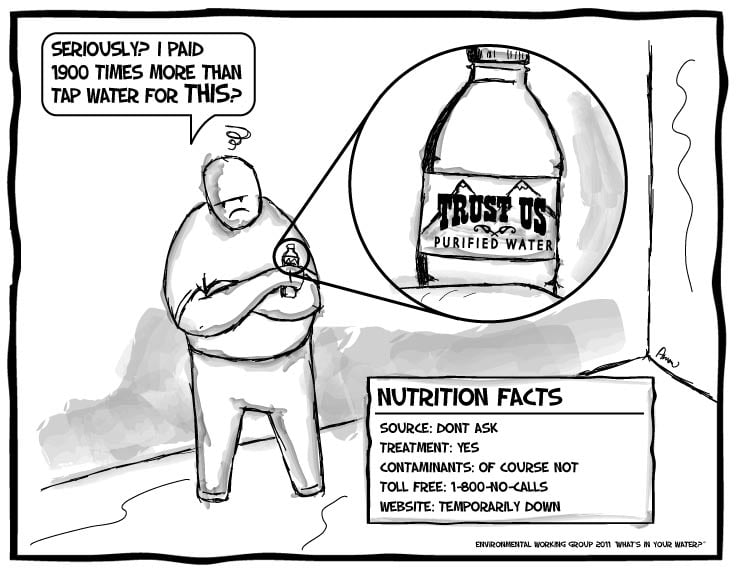
When you shell out for bottled water, which costs up to 1,900 times more than tap water, you have a right to know what exactly is inside that pricey plastic bottle.
Most bottled water makers don’t agree. They keep secret some or all the answers to these elementary questions:
  • Where does the water come from?
  • Is it purified? How?
  • Have tests found any contaminants?
Among the ten best-selling brands, nine — Pepsi's Aquafina, Coca-Cola's Dasani, Crystal Geyser and six of seven NestlĂ© brands — don't answer at least one of those questions.
Only one — NestlĂ©'s Pure Life Purified Water — discloses its water source and treatment method on the label and offers an 800-number, website or mailing address where consumers can request a water quality test report.
The industry's refusal to tell consumers everything they deserve to know about their bottled water is surprising.
Since July 2009, when Environmental Working Group released its groundbreaking Bottled Water Scorecard, documenting the industry's failure to disclose contaminants and other crucial facts about their products, bottled water producers have been taking withering fire from consumer and environmental groups.
A new EWG survey of 173 unique bottled water products finds a few improvements – but still too many secrets and too much advertising hype. Overall, 18 percent of bottled waters fail to list the source, and 32 percent disclose nothing about the treatment or purity of the water. Much of the marketing nonsense that drew ridicule last year can still be found on a number of labels.
EWG recommends that you drink filtered tap water. You'll save money, drink water that’s purer than tap water and help solve the global glut of plastic bottles.
We support stronger federal standards to enforce the consumer's right to know all about bottled water.
Until the federal Food and Drug Administration cracks down on water bottlers, use EWG's Bottled Water Scorecard to find brands that disclose water source, treatment and quality and
that use advanced treatment methods to remove a broad range of pollutants.

Friday, August 27, 2010

Message in a Bottle ~ 4th installment


n the late 1800s, Poland Spring was already a renowned brand of healthful drinking water that you could get home-delivered in Boston, New York, Philadelphia, or Chicago. It was also a sprawling summer resort complex, with thousands of guests and three Victorian hotels, some of which had bathtubs with spigots that allowed guests to bathe in Poland Spring water. The resort burned in 1976, but at the crest of a hill in Poland Spring, Maine, you can still visit a marble-and-granite temple built in 1906 to house the original spring.
24% of the bottled water we buy is tap water repackaged by Coke and Pepsi.
The car, the Depression, World War II, and perhaps most important, clean, safe municipal water, unwound the resorts and the first wave of water as business. We had to wait two generations for the second, which would turn out to be much different--and much larger.
Today, for all the apparent variety on the shelf, bottled water is dominated in the United States and worldwide by four huge companies. Pepsi has the nation's number-one-selling bottled water, Aquafina, with 13% of the market.Coke's Dasani is number two, with 11% of the market. Both are simply purified municipal water--so 24% of the bottled water we buy is tap water repackaged by Coke and Pepsi for our convenience. Evian is owned by Danone, the French food giant, and distributed in the United States by Coke.
The really big water company in the United States is Nestlé, which gradually bought up the nation's heritage brands, and expanded them. The waters are slightly different--springwater must come from actual springs, identified specifically on the label--but together, they add up to 26% of the market, according to Beverage Marketing, surpassing Coke and Pepsi's brands combined.
Since most water brands are owned by larger companies, it's hard to get directly at the economics. But according to those inside the business, half the price of a typical $1.29 bottle goes to the retailer. As much as a third goes to the distributor and transport. Another 12 to 15 cents is the cost of the water itself, the bottle and the cap. That leaves roughly a dime of profit. On multipacks, that profit is more like 2 cents a bottle.
As the abundance in the supermarket water aisle shows, that business is now trying to help us find new waters to drink and new occasions for drinking them--trying to get more mouth share, as it were. Aquafina marketing vice president Ahad Afridi says his team has done the research to understand what kind of water drinkers we are. They've found six types, including the "water pure-fectionist"; the "water explorer"; the "image seeker"; and the "struggler" ("they don't really like water that much...these are the people who have a cheeseburger with a diet soda").
It's a startling level of thought and analysis--until you realize that within a decade, our consumption of bottled water is expected to surpass soda. That kind of market can't be left to chance. Aquafina's fine segmentation is all about the newest explosion of waters that aren't really water--flavored waters, enhanced waters, colored waters, water drinks branded after everything from Special K breakfast cereal to Tropicana juice.
Afridi is a true believer. He talks about water as if it were more than a drink, more than a product--as if it were a character all its own, a superhero ready to take the pure-fectionist, the water explorer, and the struggler by the hand and carry them to new water adventures. "Water as a beverage has more right to extend and enter into more territories than any other beverage," Afridi says. "Water has a right to travel where others can't."
Uh, meaning what?
"Water that's got vitamins in it. Water that's got some immunity-type benefit to it. Water that helps keep skin younger. Water that gives you energy."
Water: It's pure, it's healthy, it's perfect--and we've made it better. The future of water sounds distinctly unlike water.
The label on a bottle of Fiji Water says "from the islands of Fiji." Journey to the source of that water, and you realize just how extraordinary that promise is. From New York, for instance, it is an 18-hour plane ride west and south (via Los Angeles) almost to Australia, and then a four-hour drive along Fiji's two-lane King's Highway.

Thursday, August 12, 2010

some bottled water facts


 did you know..

from an article at bottledwateralliance

More than a billion people around the world do not have access to safe drinking water. In Australia, we have the luxury of quality tap water, yet despite this:
  • Australians spend more than half a billion dollars a year on bottled water. Last year, the sale of bottled water increased by 10 percent. 
  • Producing and delivering a litre of bottled water can emit hundreds of times moregreenhouse gases than a litre of tap water.
  • According to British research, drinking one bottle of water has the sameenvironmental impact as driving a car for a kilometre.
  • In many cases, a litre of bottled water is more expensive than a litre of petrol.
  • Department of Environment and Climate Change estimates that 200ml of oil is used to produce, package, transport and refrigerate  each litre bottle of bottled water. As a result, at least 50 million litres of oil are used in the manufacture and distribution of bottled water in Australia every year.
  • Australia recycles only 36% of PET plastic drink bottles.
  • In South Australia, which has Container Deposit Legislation, the plastic bottle recycling rate is 74%. A 2007 national Newspoll commissioned by Clean Up Australia found that those polled 82% support a CDL scheme of 10c on bottles.
  • Australia’s annual use of bottled water generates more than 60,000 tonnes of greenhouse gas emissions - the same amount that 13,000 cars generate over the course of a year.